
Illicit flows, weak enforcement and a vast informal economy are costing Africa more than it borrows…reports Newsdesk
Africa has the potential to mobilise an additional $469.4 billion per year through stronger tax enforcement, digital reform, and simplified systems, a senior African Development Bank official said Tuesday, urging finance ministers to treat domestic revenue collection as a matter of national sovereignty.
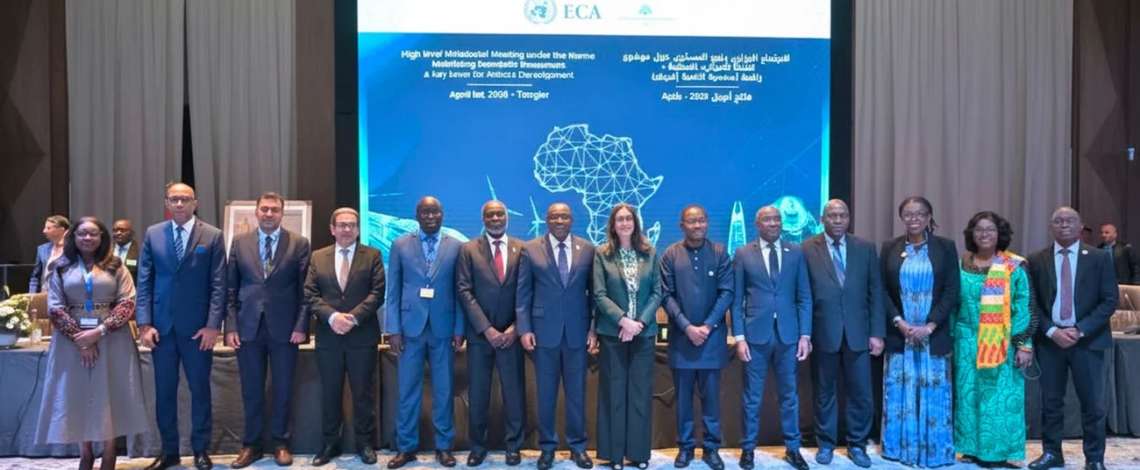
Speaking at a high-level ministerial meeting on domestic resource mobilisation in Tangier, Prof. Kevin Chika Urama, the Bank’s Chief Economist and Vice President for Economic Governance, laid out a sweeping reform agenda for African governments struggling to fund their own development.
“DRM is not merely a fiscal issue; it is a foundational enabler of development,” Urama told the gathering of African finance ministers. “Closing Africa’s DRM gap is both achievable and indispensable.”
Africa currently collects tax revenues equivalent to just 18.4% of GDP on average — well below the 27% the Bank says is needed to meet the continent’s development financing needs. The shortfall forces governments to rely heavily on external borrowing, leaving them exposed to global financial shocks and with limited room to invest in infrastructure and public services.
Urama identified a range of obstacles holding back revenue collection, including a large informal economy, weak enforcement, fragmented data systems, and complex tax procedures that raise compliance costs and create opportunities for corruption. He also pointed to illicit financial flows as a major drain, estimating they cost Africa more than $587 billion annually — losses he said were “mostly within the control of African governments.”
The Bank is currently running 31 active programmes across 22 member countries to support tax reform. Urama said experience consistently showed that digitisation — when paired with operational reforms and coordination between tax, customs and treasury agencies — delivered fast, measurable gains.
His recommendations to ministers were divided into immediate priorities and longer-term structural changes. In the near term, he urged governments to expand digital filing and payment systems, issue unique taxpayer identification numbers, link informal-sector businesses to simplified tax regimes with tangible incentives such as access to finance or government procurement, and crack down on the most distortionary tax exemptions.
Over the medium to long term, he called for the construction of fully integrated, AI-enabled revenue systems connected to customs, financial institutions, and business registries, as well as alignment with the African Continental Free Trade Area framework to reduce trade frictions and double taxation.
Urama also stressed that raising revenue was only half the challenge. “We cannot talk about DRM without talking about efficient utilisation of mobilised resources,” he said, arguing that citizens’ willingness to pay taxes depended on visible returns in the form of public services.
The African Development Bank has launched several initiatives to support the agenda, including a Public Finance Management Academy, a Macroeconomic Policy Management Academy, and a newly created Public Service Delivery Index for Africa to track progress in service delivery and help rebuild public trust in governments.
The Bank is also developing a New African Financial Architecture under the leadership of its President, Akinwumi Adesina, aimed at mobilising development finance at scale and strengthening Africa’s standing in global financial markets.
“With the right combination of technology, stronger institutions, and fair, transparent rules, rapid and tangible progress is within reach,” Urama said in closing.