

Commuters stranded and businesses disrupted as transport operators protest record fuel costs….reports Africa Newsdesk
Thousands of commuters across Kenya were left stranded on Monday while businesses and schools faced widespread disruption after public transport operators launched a nationwide strike to protest against soaring fuel prices.
Major roads in the capital Nairobi remained largely deserted as buses, minibuses and trucks stayed off the streets in a coordinated shutdown led by transport sector groups. Many commuters were forced to walk long distances to work after public transport services were suspended.
According to a report by BBC News, businesses in several parts of Nairobi remained closed, while some schools advised students to stay at home due to transport difficulties and security concerns.
The protests erupted days after Kenyan authorities raised fuel prices to record levels, with diesel and petrol prices reportedly increasing by more than 20 per cent.
Demonstrators barricaded roads and lit fires in several areas as tensions escalated. In parts of Nairobi and other regions, police used tear gas to disperse protesters following clashes and reports of motorists being stopped and harassed.
The strike comes amid mounting anger over the rising cost of living, with transport operators accusing the government of failing to protect ordinary citizens from surging fuel costs.
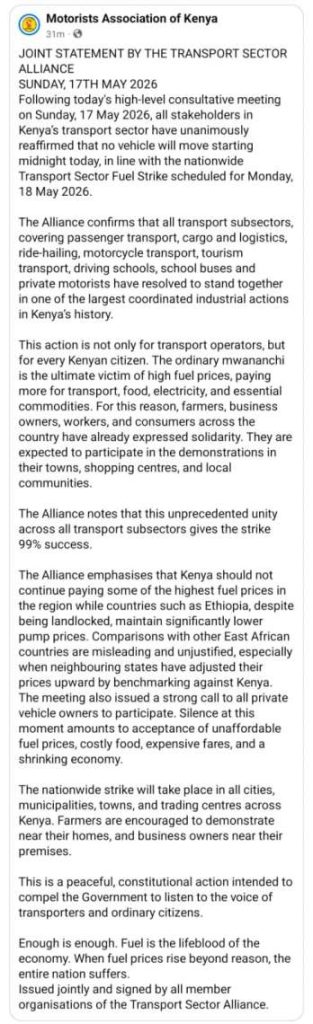
The Transport Sector Alliance, which represents transport operators, had earlier urged all vehicle owners, including private motorists, truck drivers and public transport operators known locally as matatus, to stay off the roads.
“This action is not only for transport operators, but for every Kenyan citizen,” the alliance said in a statement.
Kenya, like many African countries, depends heavily on fuel imports from Gulf nations. The disruption of shipping routes linked to the US Israel conflict with Iran has contributed to rising global fuel prices, even after a ceasefire was declared.
The closure of the Strait of Hormuz, a critical oil transit route through which around one fifth of the world’s oil supply passes, has continued to affect international energy markets.
Kenya’s Energy and Petroleum Regulatory Authority last week increased fuel prices to as high as 242 Kenyan shillings per litre for diesel and petrol.
Treasury Minister John Mbadi acknowledged that the fuel price hikes were hurting the economy but criticised the nationwide strike.
Speaking to local broadcaster NTV, Mbadi described the protests as “completely uncalled for” and said the government could not solve a global energy crisis through domestic measures alone.
The rising fuel prices have triggered increases in transport fares, food prices and the cost of other essential goods and services, intensifying pressure on households already struggling with inflation and economic hardship.
Last month, the Kenyan government temporarily reduced fuel VAT from 16 per cent to 8 per cent until July, though critics argue the move has failed to ease the burden on consumers.