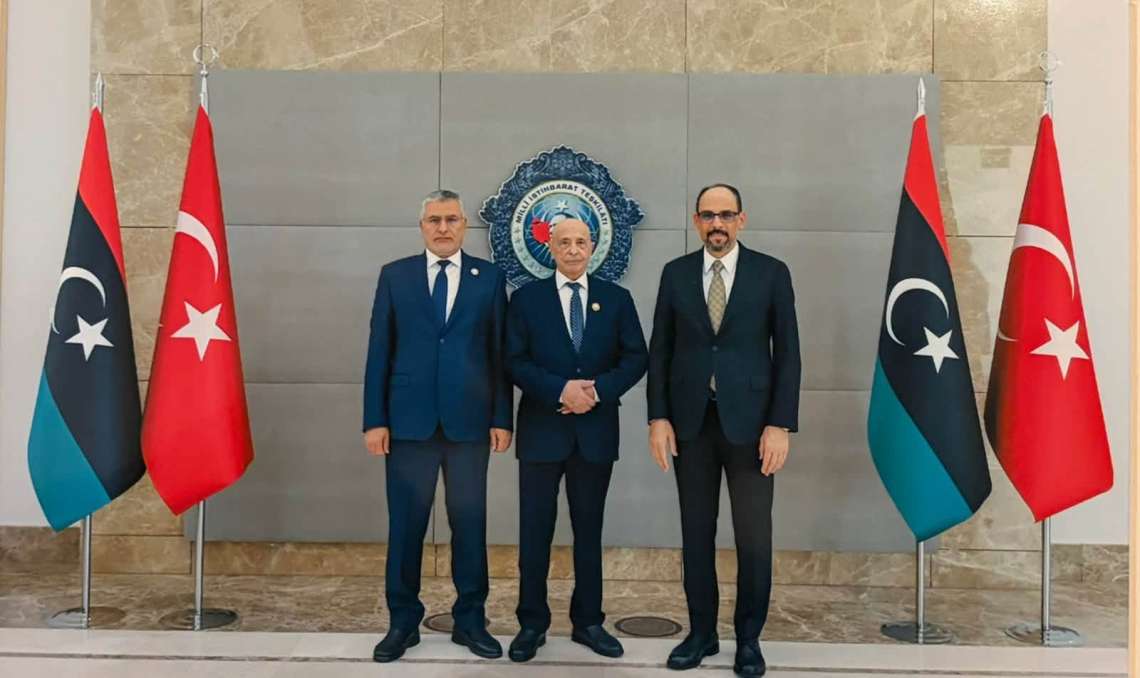

House of Representatives and High Council of State agree to revive the 6+6 Committee and advance electoral laws….reports Asian Lite News Desk
Libya’s House of Representatives (HoR) and High Council of State have stressed that the country’s political process must remain within the framework of the Constitutional Declaration and the Political Agreement governing the work of the two bodies.
The two legislative institutions also called for their respective mandates and powers to be respected, following a meeting between HoR President Aguila Saleh and High Council of State President Mohamed Takala held under the auspices of Turkey.
In a joint statement, the bodies expressed readiness to host the joint “6+6 Committee” in the coming days to allow it to resume work on electoral laws and help pave the way for presidential and parliamentary elections.
The “6+6 Committee”, formed jointly by the HoR and High Council of State, reached an agreement in June 2023 on legislation governing the elections. The HoR subsequently adopted amended versions of the electoral laws in October 2023, Xinhua News Agency reported.
However, the High Council of State objected to several of the amendments and supported the version agreed upon by the committee in Bouznika, Morocco. The disagreement contributed to delays in implementing the laws and brought the committee’s work to a halt amid broader disputes over the formation of a unified executive authority and the conditions for holding elections.
The latest move comes after Libya’s “4+4 Committee” reached a final agreement on August 30 under the auspices of the United Nations Support Mission in Libya (UNSMIL).
The agreement seeks to establish conditions for presidential and parliamentary elections within a maximum period of 24 months, under a single executive authority and unified national institutions.
Among its key provisions are the restructuring of the board of the High National Elections Commission and efforts to resolve outstanding issues in the electoral laws.
The agreement proposes allowing military personnel to vote and stand in presidential elections. It also allows dual nationals to contest the presidency, provided the winner gives up their non-Libyan citizenship before taking the constitutional oath.
It further sets the number of endorsements required for a presidential candidate at 20,000 and assigns the elected House of Representatives responsibility for drafting a permanent constitution for Libya.
Libya has remained politically divided between rival institutions and administrations since the fall of Muammar Gaddafi in 2011, with repeated efforts to organise national elections facing political and legal obstacles.