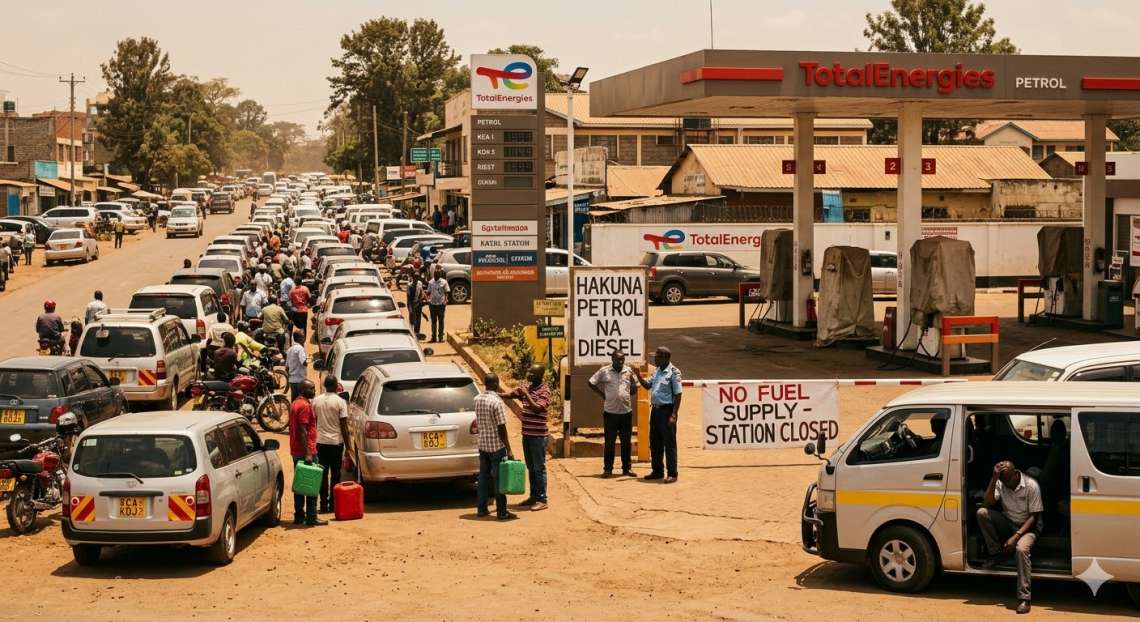

Hundreds of fuel retailers across Kenya are already experiencing supply constraints, with about 20 percent of the country’s roughly 3,100 independent dealers affected, Newsdesk reports
Kenya is facing growing uncertainty over fuel supplies as disruptions linked to the Middle East conflict begin to ripple through the country’s energy sector, with industry players warning of shortages even as the government insists there is no immediate crisis.
According to Business Insider Africa, hundreds of fuel retailers across Kenya are already experiencing supply constraints, with about 20 percent of the country’s roughly 3,100 independent dealers affected. Martin Chomba, chairman of the Petroleum Outlets Association of Kenya, told Reuters that the situation could deteriorate rapidly if tensions in the Middle East persist. His association represents a significant portion of the market, covering about 68 percent of national fuel distribution.
“We have constrained supply,” Chomba said, warning that within two weeks the situation could escalate into a full blown crisis, leaving most outlets without fuel if disruptions continue.
Kenya relies entirely on fuel imports from the Middle East under government facilitated agreements with major Gulf suppliers, making it particularly vulnerable to geopolitical shocks. Earlier in March, global oil prices surged as conflict involving the United States, Israel, and Iran disrupted shipping routes through the Strait of Hormuz, a critical passage through which around 20 percent of the world’s oil supply flows.
In response to rising global prices, the Energy and Petroleum Regulatory Authority froze domestic fuel prices for 30 days from March 14, a move that has added pressure on retailers already grappling with tighter margins and supply challenges. Industry players are now urging authorities to allow sourcing from alternative private suppliers to ease shortages.
However, the government has pushed back against claims of an emerging crisis. According to Daily Nation, Energy Cabinet Secretary Opiyo Wandayi has maintained that Kenya has sufficient fuel stocks and robust contingency plans in place. Speaking on Tuesday, Wandayi sought to reassure the public and discourage panic buying.
“There is no crisis at the moment. We have enough stocks of all petroleum products,” he said, adding that measures had been developed to cushion the country against potential disruptions to existing supply arrangements with Saudi Aramco, Abu Dhabi National Oil Company, and Emirates National Oil Company.
The conflicting signals from industry stakeholders and government officials have created confusion over the true state of fuel availability, as reports of dry petrol stations continue to emerge in different parts of the country.
Amid these concerns, easing tensions between the United States and Iran have offered a degree of relief to global markets. The pause in military escalation has raised hopes of smoother oil flows through key transit routes, potentially stabilising prices and improving supply conditions.
For countries like Kenya, which depend entirely on imported energy, such geopolitical shifts have immediate and far reaching consequences. Rising tensions around the Strait of Hormuz typically translate into higher fuel costs, supply uncertainty, and increased pressure on household expenses, from transport to food.
The recent developments have also reignited debate about Kenya’s long term energy security. Analysts and observers argue that the current situation highlights the urgent need for diversification of fuel sources, greater investment in strategic reserves, and a faster transition towards renewable energy.
There are also calls for stronger regional cooperation to cushion economies against external shocks, particularly in the Global South where dependence on imported energy remains high.
While the immediate outlook may improve if stability returns to key global supply routes, the episode underscores the vulnerability of import dependent economies to geopolitical disruptions, and the importance of building more resilient and diversified energy systems for the future.