
Kenya breaks ground on a $16bn refinery designed to transform East Africa’s fuel supply, boost local processing and strengthen regional industrial capacity…reports Africa Daily News Desk
Kenya has broken ground on a $16 billion oil refinery in the coastal town of Lamu, in one of Africa’s biggest new industrial projects, as regional leaders push for greater domestic processing of the continent’s natural resources.
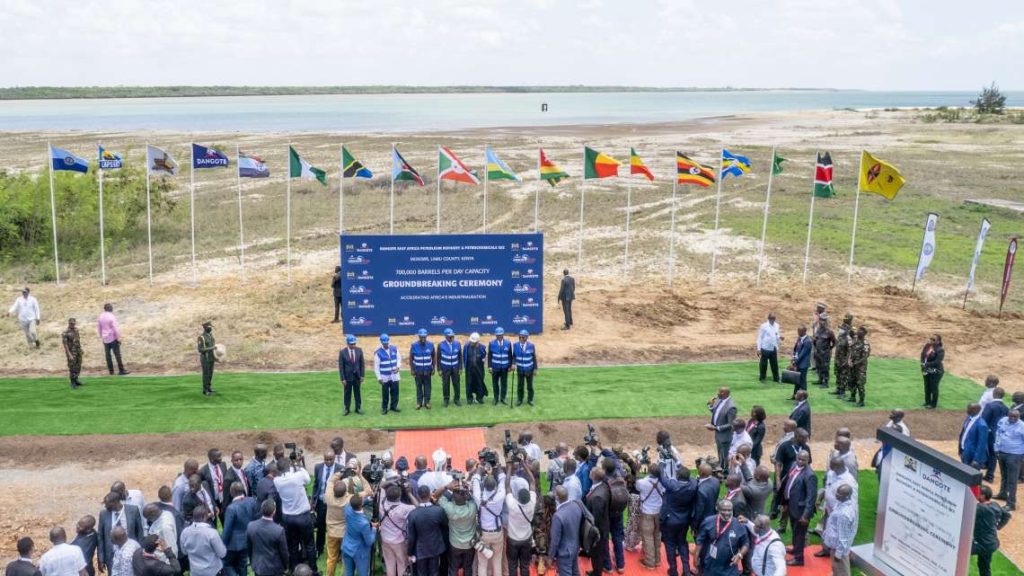
Kenyan President William Ruto and Nigerian billionaire Aliko Dangote led the ceremony, joined by the presidents of Uganda, Ethiopia, Togo and Benin and former Nigerian president Olusegun Obasanjo.
The refinery is expected to process up to 700,000 barrels of crude oil a day when completed, with construction planned to take about 40 months. Dangote has said the facility is expected to be operational by 2030.

The project is designed to supply refined petroleum products to Kenya and other East African markets, reducing the region’s dependence on imported fuel. It will use crude sourced from neighbouring oil-producing countries, including Uganda, as well as supplies from elsewhere.
Speaking at the launch, Dangote argued that Africa needs to move beyond exporting raw materials and importing finished products.
“Africa must industrialise Africa,” he said, arguing that the continent should process more of what it produces domestically.
Ruto similarly presented the refinery as part of a wider shift towards African manufacturing and value addition, saying the project represented a new stage in the continent’s industrial development.
The scale of the planned refinery reflects the size of the East African market. Dangote has argued that regional countries consume substantially more petroleum products than the planned facility will produce.
The project is also expected to create thousands of jobs and attract further investment into Lamu and the wider coastal region. Associated infrastructure and supply chains could include storage, transportation, engineering and other services.
Regional governments have also been offered a combined stake of up to 30% in the refinery, according to Reuters. Kenya and other participating governments are expected to acquire shares, giving neighbouring countries a direct interest in the facility.
The project follows the experience of Dangote’s giant refinery near Lagos, which has helped Nigeria reduce its dependence on imported petroleum products and become an emerging exporter of refined fuel.
Dangote has said the Lamu facility will replicate lessons learned from the Nigerian project, potentially allowing construction to move more quickly.
The choice of Lamu followed an earlier proposal to build the refinery at Tanga in Tanzania. Dangote said Lamu offered deeper waters, suitable ground for heavy industrial equipment and access to deep-sea shipping.
The project does not mean East Africa is abandoning plans for smaller national refineries.
Ugandan President Yoweri Museveni said his country would continue pursuing its own refinery plans because the region needs more than one or two facilities.
Uganda is developing oil resources around Lake Albert and has long sought to process some of its crude domestically rather than export it in raw form.
Museveni has argued that refining locally would allow Uganda to capture more value from its oil resources and strengthen domestic energy security.
The Lamu refinery could nevertheless provide a major regional outlet for Ugandan crude and other African supplies.
Land dispute casts shadow
Despite the project’s scale and political backing, construction faces a legal challenge from residents in Lamu.
A group of 133 residents has petitioned Kenya’s Environment and Land Court, arguing that land earmarked for the refinery is ancestral property that has been occupied and farmed by local families for generations. They are seeking recognition of their land rights, compensation and resettlement arrangements.
The court ordered the parties to maintain the existing status quo on the disputed parcel until a hearing scheduled for October 14. The order did not prevent the ceremonial groundbreaking, although Dangote’s group acknowledged that activities at the site could be affected by the proceedings.
Residents also staged protests demanding greater compensation, while environmental campaigners have raised concerns about the potential impact of the refinery on Lamu’s coastal ecosystem.
The Save Lamu campaign has called for access to the project’s environmental impact assessment and details of proposed mitigation measures.