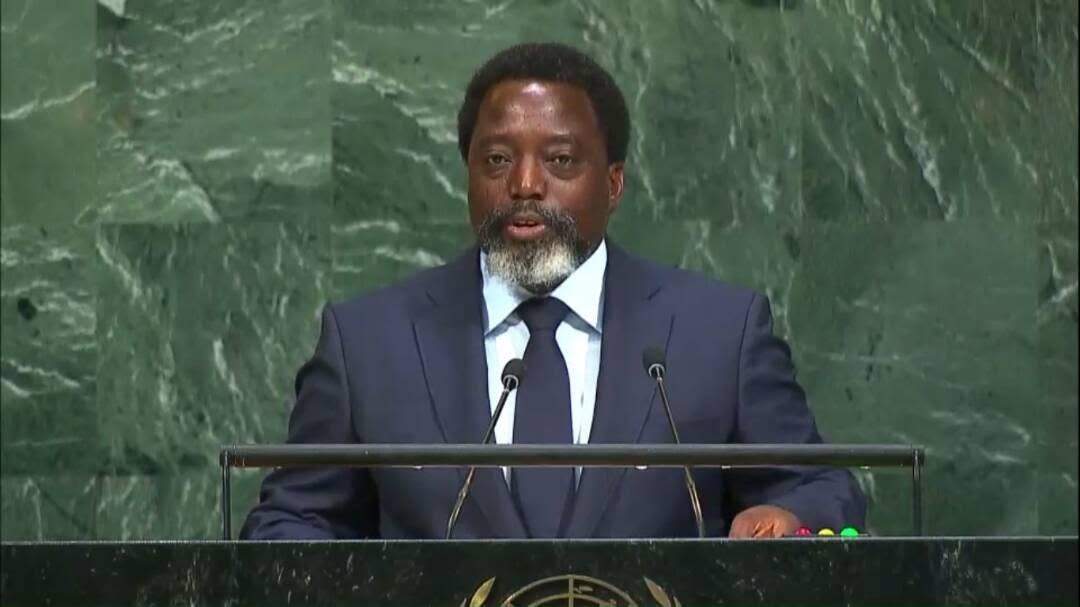

Former president Joseph Kabila has joined a new political-military coalition challenging President Felix Tshisekedi. The move has raised fears that the conflict in eastern DR Congo could continue…reports Africa Daily News Desk
The return of former president Joseph Kabila to the centre of the Democratic Republic of the Congo’s political conflict has raised fresh questions about the country’s democratic future, as a new coalition challenges President Felix Tshisekedi and calls for resistance, including through force.
The Front pour la Refondation de la Nation (FRN), or Front for the Refoundation of the Nation, was announced in Goma on Monday evening. Led by Kabila, the coalition replaces the existing alliance between the Alliance Fleuve Congo (AFC) and the March 23 Movement (M23), bringing together figures and forces associated with the two movements.
The group accuses Tshisekedi of tyranny and presents itself as a challenge to his government. Its emergence places a former head of state directly within the leadership of an armed rebellion, adding a new political dimension to the conflict.
Goma, the main city in North Kivu province, has been under M23-AFC control since January last year. The wider conflict has displaced millions and drawn in neighbouring countries, with longstanding regional rivalries, security concerns and competition over territory and mineral resources contributing to the crisis.
M23 says it took up arms because the Congolese government failed to honour earlier commitments. Kinshasa and international actors have accused Rwanda of supporting the group, but Kigali denies the allegations and points to security threats from armed groups operating in eastern Congo.
For residents of Goma, Kabila’s decision has raised concerns that the conflict could become more difficult to resolve. As reported by Al Jazeera, resident Basa Juhudi said he had expected the war to end soon and had hoped government forces would regain control of the city.
“As a resident of Goma, I believed the war might end in the very near future, hoping that the Congolese government would liberate us. And we are greatly surprised that even our former president has joined the fray,” he told Al Jazeera.
Juhudi said Kabila’s experience and knowledge of the country made his involvement particularly worrying.
“The fact that Joseph Kabila has joined the rebellion, bearing in mind that he is our former president and knows this country inside out, means the war is far from over. I am not happy about this frightening situation.”
His concerns extend beyond the fighting to the future of democracy in the country.
“Today, I am very afraid. I don’t know if I will be lucky enough to experience a proper democracy in the DRC. I was delighted by the country’s very first peaceful transfer of power,” he said, referring to the 2019 transition when Tshisekedi succeeded Kabila.
Kabila came to power in 2001 after the assassination of his father, Laurent-Desire Kabila. He was elected president in 2006 and re-elected in 2011. His second term was due to end in 2016, but elections were delayed, prompting accusations from critics that he was seeking to remain in power beyond the constitutional limit.
Protests over the delays were met with deadly violence before a political compromise paved the way for elections in December 2018. Tshisekedi was declared the winner and took office in January 2019.
Kabila defended the delays, arguing that the Congolese people had ultimately resolved their problems through dialogue.
His alignment with the FRN now brings his political confrontation with Tshisekedi into the context of an armed challenge to the government. Whether he can translate his political experience and networks into wider support remains uncertain.
The latest realignment leaves the prospects for peace unclear, while residents in eastern Congo face continued uncertainty over security, political stability and the possibility of a lasting settlement.