

The incoming president is expected to confront mounting security challenges and entrenched poverty, particularly in the country’s northern regions….reports Asian Lite News
The Commission Électorale Nationale Autonome (CENA) has announced provisional results of Benin’s presidential election, showing a decisive victory for finance minister Kossi M. Romuald Wadagni and his running mate Mariam Chabi Talata.
According to the official decision released on Tuesday, the Wadagni Talata ticket secured 4,252,347 votes, accounting for an overwhelming 94.05 per cent of ballots cast. Their closest challengers, Paul Hounkpe and Rock Judicaël Hounwanou, received 269,433 votes, or 5.95 per cent.
In the absence of a credible opposition, the election was widely seen as a foregone conclusion, according to BBC. The incoming president is expected to confront mounting security challenges and entrenched poverty, particularly in the country’s northern regions.

The JNIM group has intensified its attacks, killing 54 soldiers in April last year, followed by another assault last month that left 15 troops dead. The worsening security situation was also cited by soldiers as a key reason behind an attempted coup four months ago.
Despite these challenges, Benin, home to around 15 million people, remains one of West Africa’s more stable democracies, even as the region has witnessed a series of military coups in recent years.
The results, based on 90.55 per cent of processed polling stations, point to a commanding lead that authorities described as mathematically irreversible at this stage.
CENA reported that out of 7,897,287 registered voters, a total of 4,640,354 people cast their ballots, reflecting a voter turnout of 58.75 per cent. Of these, 4,522,756 votes were deemed valid, while 117,598 ballots were invalid.
The electoral body noted that voting took place across the national territory as well as in overseas polling centres. While some disturbances were reported in parts of northern Benin, officials said security forces ensured the smooth conduct of the election, allowing citizens to freely exercise their constitutional rights.
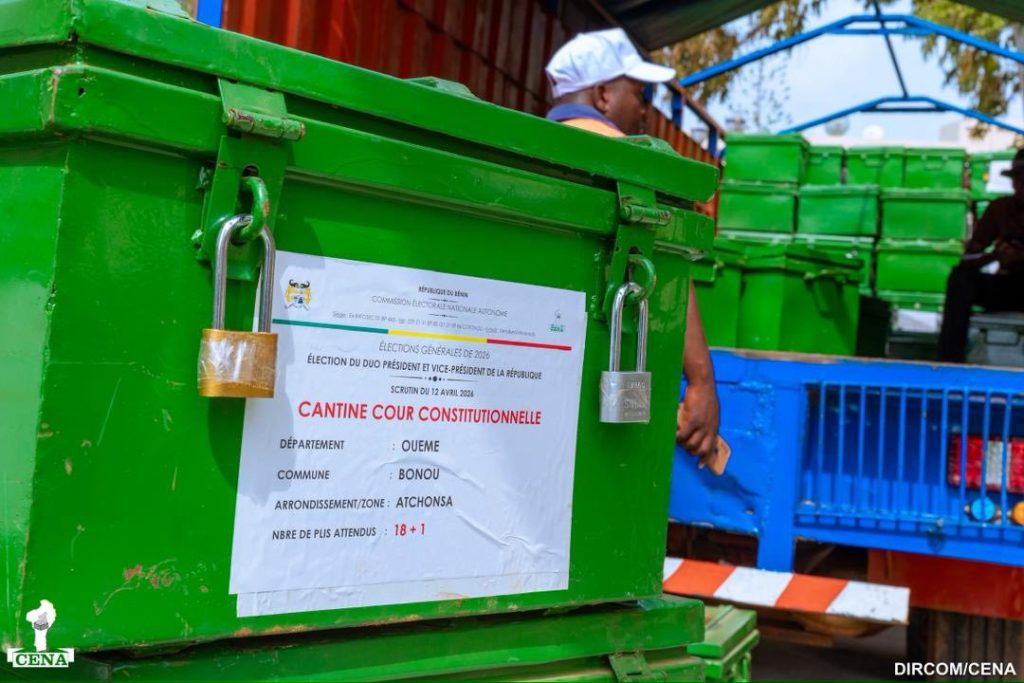
Authorities also highlighted the role of digital systems in the transmission of results, stating that the process ensured speed, transparency, and traceability in compiling nationwide data.
CENA emphasised that the wide margin between the leading candidates means that even the remaining uncounted votes are unlikely to alter the outcome of the election.
Under Benin’s electoral framework, the announced figures remain provisional and are subject to validation by the Constitutional Court, which has the final authority to confirm the results.
The decision, signed in Cotonou on April 13, will be formally recorded and published in the country’s official gazette following legal procedures.
If upheld, the outcome would mark a resounding electoral mandate for Wadagni and Talata, setting the stage for the next phase of governance in the West African nation.