
Uganda is considering recruiting skilled citizens repatriated from South Africa into the Uganda People’s Defence Forces as part of efforts to support their reintegration…reports Africa Daily News Desk
The Ugandan government is considering recruiting skilled citizens recently repatriated from South Africa into the Uganda People’s Defence Forces (UPDF) as part of broader efforts to reintegrate them into society and make use of the expertise they acquired while living abroad.
Minister for Gender, Labour and Social Development Lt. Gen. Henry Tumukunde said the government would hold discussions with Chief of Defence Forces Gen. Muhoozi Kainerugaba on the possibility of recruiting qualified returnees who have expressed an interest in joining the military.
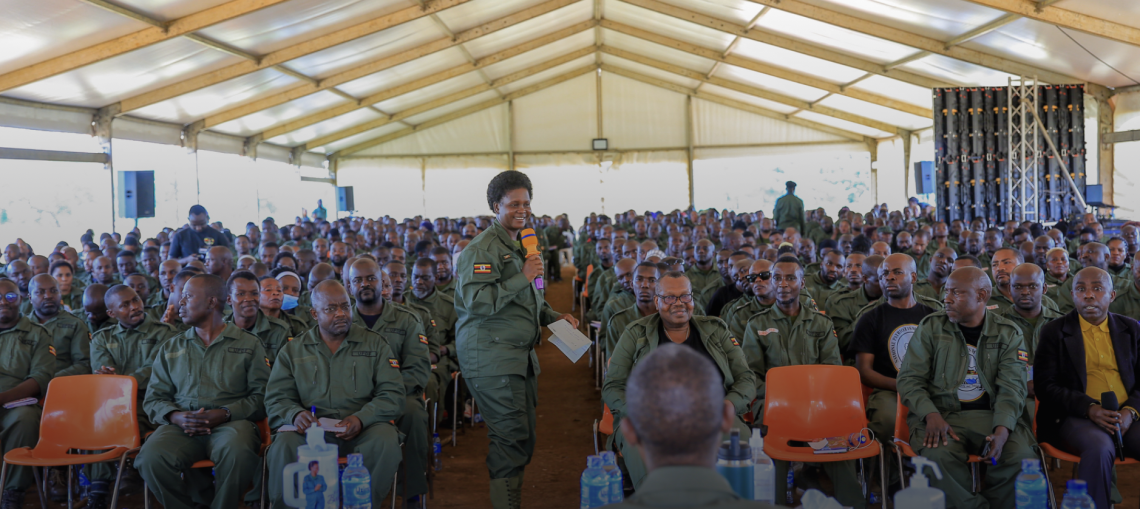
Speaking during a lecture on employment and reintegration opportunities at the National Leadership Institute (NALI) in Kyankwanzi, Lt. Gen. Tumukunde said many of the more than 1,000 returnees currently undergoing rehabilitation and ideological orientation possessed professional skills that could benefit the country.
“We have many of them who are drivers, and I think the army wouldn’t mind having professional drivers. We shall discuss with General Muhoozi Kainerugaba, who has been very helpful in bringing these people back, to see whether we can absorb some of them directly because they are very skilled,” he said.
According to the minister, many of the returnees had worked as Uber drivers and in other specialised occupations in South Africa, making them a valuable resource for Uganda’s economy.
The current group undergoing the re-entry programme comprises 1,030 Ugandans, including 331 children.
Lt. Gen. Tumukunde said the returnees represented a diverse pool of skilled professionals, including plumbers, refrigeration and cooling systems technicians, dog handlers, trainers, machine operators and workers from several other technical fields.
“I must say that this is a very big pool of skilled people, ranging from plumbers, refrigeration and cooling systems technicians, dog handlers and trainers, machine operators, and many other professions,” he said.
The minister said the government had initially expected reintegration challenges but had instead encountered a disciplined and highly skilled group capable of contributing to Uganda’s socio-economic development.
“I came here worried that we were going to receive people who would struggle to fit into our society, but I am extremely impressed. Despite what we are calling a bad experience, Uganda is receiving back people with valuable skills,” he said.
He said the government planned to identify highly skilled returnees and support them in training other Ugandans, while helping others establish businesses through existing government empowerment programmes.
“We shall ensure that those who are highly skilled are supported to teach others. Those who want to start businesses will receive assistance, and we are also organising them into a pool of skilled workers so that Ugandans can easily access their services,” he said.
Lt. Gen. Tumukunde said returnees would also benefit from government initiatives including the Generating Growth Opportunities and Productivity for Women Enterprises (GROW) Project, the Youth Livelihood Programme and Emyooga.
He urged the returnees to remain law-abiding citizens as they reintegrate into society.
“I warned them about lawlessness because South Africa has developed tendencies towards lawlessness. That is not something we are going to accommodate here,” he said.
Expressing confidence in Uganda’s capacity to receive more returning citizens, the minister said the government remained committed to welcoming all Ugandans who wished to come home.
“‘Enjovu teremererwa masanga gaayo’ (An elephant is never burdened by its own tusks). We shall receive them. They are in a very good mood, very impressive, and they will receive certificates after completing this re-entry course,” he said.
The minister noted that although an estimated one million Ugandans are believed to be living in South Africa, only about 1,000 have so far returned under the first phase of the voluntary repatriation exercise.
“We need to be even more receptive to their return,” he said, adding that Africa’s development remained the responsibility of Africans. “Either way, the business of developing Africa is ours.”
Meanwhile, NRM Chapter South Africa Chairperson Luzige Isma urged Ugandans still living in South Africa who wished to return home to remain patient as the government prepared subsequent phases of the voluntary repatriation programme.
The rehabilitation and ideological orientation programme at NALI Kyankwanzi is being coordinated by the National Secretariat for Patriotism Corps under Commissioner Hellen Seku. The programme also included presentations by Uganda Media Centre Executive Director Alan Kasujja and Uganda Police Force spokesperson ACP Kituuma Rusoke on responsible citizenship, personal security, crime prevention and the responsible use of social media.
The current cohort of returnees is expected to complete the programme on Friday during a pass-out ceremony to be presided over by President Yoweri Kaguta Museveni, who initiated the repatriation programme following recent xenophobic violence in South Africa.
The programme is intended to provide ideological orientation, support the returnees’ reintegration into Ugandan society and connect them with government initiatives promoting employment, skills development, entrepreneurship and wealth creation.