
Ethiopia has broken ground on a vast new airport outside Addis Ababa that its government says will become the largest on the African continent, signalling an ambitious push to cement the country’s status as a global aviation hub…reports Asian Lite News
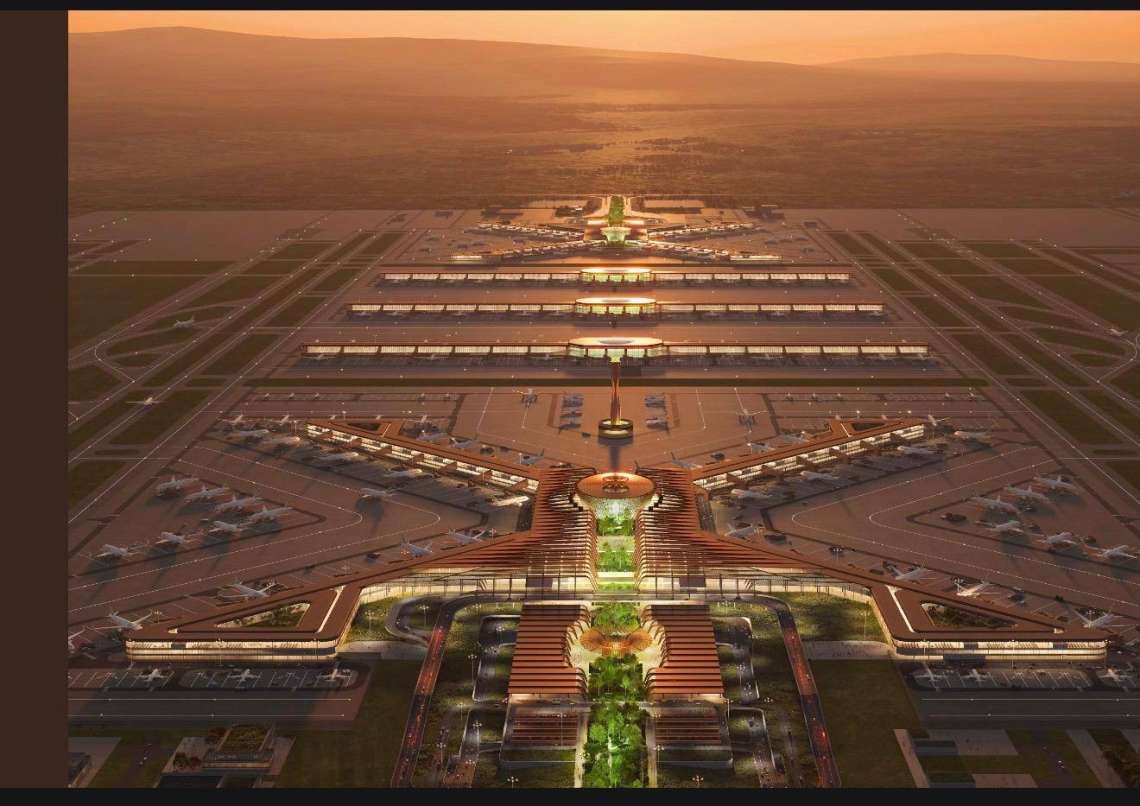
Ethiopia on Saturday began construction of what the prime minister says will be Africa’s largest airport, when completed, in the town of Bishoftu, southeast of the capital, Addis Ababa. The scale of the project underlines the government’s confidence in long-term growth in air travel to and through Ethiopia, despite near-term economic and political headwinds.
The massive travel hub is expected to cost approximately $12.7 billion and will eventually be able to handle around 110 million passengers per year at full capacity, placing it among the world’s busiest airports. Construction is expected to take five years, with planners envisioning a phased build-out that allows sections of the airport to come online as demand grows. Officials say the design will include multiple runways, extensive cargo handling facilities and space for future expansion, reflecting Ethiopia’s aim to compete with established intercontinental hubs in the Middle East and Europe.
Partly financed by national carrier Ethiopian Airlines, the Bishoftu hub is expected to replace the capital’s Bole International Airport, which can handle up to 25 million passengers annually and has faced capacity constraints as the airline has expanded its network. Ethiopian Airlines has grown into one of Africa’s most profitable and far-reaching carriers, and the government sees aviation as a cornerstone of its broader development strategy.
Prime Minister Abiy Ahmed on Saturday announced construction of “the largest aviation infrastructure project in Africa’s history” had begun. “This multi-airport strategy aims to future-proof Ethiopia’s role as Africa’s leading air transport gateway,” he said in a post on X. He added that the project will strengthen Ethiopian Airlines’ global competitiveness, enhance African connectivity, expand trade and tourism corridors, and position Ethiopia as a major intercontinental hub.
The development is not limited to runways and terminals. The project includes a multi-lane motorway to link the new facility to the capital and a 38-kilometre high-speed railway, which Abiy said would reach speeds of up to 200 kph. These links are intended to integrate the airport into the wider metropolitan economy and reduce congestion around Addis Ababa, while also supporting logistics and cargo movements across the region.
Financing for the airport reflects a blend of domestic commitment and international support. The African Development Bank has earmarked $500 million for the project, and Ethiopian authorities are in talks to raise additional tranches with the Asian Development Bank, the European Investment Bank, and the US Development Finance Corporation. Securing favourable financing terms will be critical, given Ethiopia’s broader fiscal pressures and the sheer size of the investment.
The government hopes the new airport will help attract foreign tourists and business travellers, even as the country grapples with ongoing armed conflict in its two most populous regions, Amhara and Oromia. Bishoftu itself is located in Oromia, a factor that has heightened scrutiny of security and local engagement plans around the project.
The future airport, which will sit on a 35-square-kilometre site, has already had significant social impacts. About 2,500 farmers were displaced to make way for the development and were re-housed last year at a cost of $350 million, Ethiopian Airlines chief executive Mesfin Tasew Bekele said in November. The resettlement programme has been cited by officials as evidence of efforts to mitigate the human cost of large-scale infrastructure, though such projects remain sensitive in a country where land and livelihoods are closely tied.
With a population of around 130 million, Ethiopia is Africa’s second-most populous country and has embarked on a series of high-profile infrastructure schemes in recent years as it seeks to accelerate industrialisation and urbanisation. It officially inaugurated the continent’s largest dam last year, and extensive urban renewal projects are under way in Addis Ababa and other major cities. Supporters argue that these investments lay the foundations for long-term growth and regional influence, while critics warn of rising debt and the risks of pushing ahead amid political instability.
The Bishoftu airport project encapsulates both the ambition and the challenges of Ethiopia’s development drive: a bid to reshape the country’s economic geography and global standing, even as it navigates conflict, financing constraints and the complex realities on the ground.